Practical endurance fuelling

Build a fuel plan you can still follow late in the day

Start with the work in front of you: duration, intensity, terrain, conditions and access. Choose a carbohydrate range, turn it into labelled portions, practice the timing and change one variable at a time. The best plan isn’t the highest number. It’s the one you can tolerate, carry and keep using when the course gets awkward.

Mountain biker taking fuel during a long endurance ride

The short answer

Start with the session, not the biggest number

Updated 26 July 202613 minute guide

Short, easy sessions often need no special fuel while you train. As duration or intensity rises, carbohydrate during exercise can support performance, but the useful amount still depends on the work and your tolerance. Use established ranges as a starting point, not a contest. Build ordinary meals around training, practice the relevant hourly intake, count drinks as well as food, and don’t arrive on race day with a high target you’ve never tested.

Ready-made fuel packs

Choose a ready-made fuel pack

Compare ready-made 2-, 4- and 6-hour starting points by brand, then use this guide to adjust timing, access and conditions.

Explore all Fuel Packs

Loading available fuel packs…

Use this guide

Build the plan in six useful decisions

Use the session table to find a starting range, then work through the full sequence before relying on it in a long race, ride, triathlon, trail event or exposed day out.

Read the session demand

Let the session decide what the plan has to do

An easy forty-minute run, a hard ninety-minute race and a steady six-hour ride don’t create the same fuelling problem. The 2016 joint position paper from the Academy of Nutrition and Dietetics, Dietitians of Canada and the American College of Sports Medicine puts the familiar during-exercise ranges inside the full day: daily intake, food before exercise, fuel during the work and recovery between sessions.

That context matters. A product page can’t see whether you ate breakfast, how technical the trail is, whether bottles are available, how hot the venue becomes or how your gut behaves at race effort. Start with the closest evidence-led range, then let your own training narrow it.

Duration

Count the whole working day

Include the warm-up, long transitions, repeated climbs and the part of the course where eating gets difficult. A three-hour event doesn’t become a two-hour fuelling problem because the final hour looks slower on paper.

Intensity

Ask what the effort does to eating

Higher intensity can increase carbohydrate demand while making chewing, opening packets and tolerating concentrated fuel harder. Practice at the effort and movement pattern that exposes the problem, not only on a gentle spin.

Starting state

Bring yesterday and tomorrow into the plan

An early session after a light evening meal, a second workout on the same day and a race after travel are different problems. Daily food, the pre-session meal and recovery can matter more than another emergency gel.

Access

If you can’t reach it, it isn’t available

Mark aid stations, feed zones, pockets, bottles, drop bags and the periods when your hands are occupied. Fuel you can’t reach, open or swallow at the planned time isn’t part of the usable plan.

Decision aid

Find the range that fits the duration

These broad ranges come from established sports-nutrition guidance. They aren’t a diagnosis, a minimum for every athlete or proof that more is better.

Use the nearest row to begin testing, then record performance, tolerance and access.
DurationTypical problemEvidence-led starting pointCheckBoundary
Under about 45 minutesEasy or ordinary trainingUsually ordinary meals and water are enoughStarted fed, conditions and medical needsDo not add products by habit
About 45 to 75 minutesSustained high intensitySmall carbohydrate amounts or a mouth-rinse strategy can be usefulPractical value and individual responseKeep the method simple
About 1 to 2.5 hoursEndurance or stop-start workEstablished guidance commonly uses 30 to 60 grams per hourIntensity, breakfast, carrying and toleranceBegin inside the range and test
Beyond about 2.5 to 3 hoursLong endurance eventsGuidance extends up to 90 grams per hour using mixed carbohydrate sourcesGut training, concentration, access and total energyThe upper end is earned, not automatic
Very long or ultra eventsLower intensity with many hours of eatingCarbohydrate remains central but food variety and total energy become practical concernsAid gaps, flavour fatigue, chewing and paceUse event-specific professional advice where needed

On a phone, swipe the table sideways to compare every column.

Fuel before the start

Don’t ask race fuel to repair a hungry week

Fuel during exercise works best when you’re eating enough overall. It can’t fully repair a week of missed meals or turn every depleted session into productive training. World Athletics and the joint sports-nutrition position paper both recommend matching carbohydrate availability to the importance and demand of the session.

Some advanced athletes deliberately complete selected low-carbohydrate-availability sessions under professional supervision. However, a systematic review found no overall endurance-performance advantage from periodised carbohydrate restriction compared with normal high availability in trained athletes. Accidental restriction isn’t a performance system. Protect key sessions, competition and recovery, and discuss any deliberate restriction with a registered sports dietitian.

Ordinary day

Let meals do the everyday work

Place carbohydrate foods around the sessions that need quality and account for the whole training week. Rice, potatoes, bread, oats, pasta, fruit and other familiar foods can do most of this work. Sports products solve portability and timing, not the whole diet.

Pre-session meal

Give a bigger meal more time

The established 1 to 4 grams per kilogram in the 1 to 4 hours before exercise is a broad framework, not a target to force. A larger meal needs more time. Closer to the start, choose a smaller familiar option that fits your appetite, movement and bathroom access.

Early start

Practice the early-start compromise

If a full breakfast is unrealistic, test a smaller low-fibre option, a drink, a snack on waking or more preparation the evening before. The answer is individual; the useful bit is practicing the exact alarm-to-start schedule.

Health boundary

Do not normalise persistent under-fuelling

Repeated fatigue, declining performance, recurrent injury, disrupted menstrual function, low mood or an unhealthy preoccupation with food and weight deserve qualified support. Sports nutrition should protect health as well as one result.

Endurance athlete eating a familiar carbohydrate meal outdoors
Ordinary meals create the foundation; products solve timing, portability and access.

Build the hourly plan

Turn the hourly range into portions you can see and reach

The 30 to 60 and up-to-90 grams-per-hour ranges are planning tools. They don’t mean every two-hour session needs sixty, every long event needs ninety or body size alone decides the answer. A 2024 systematic review and meta-analysis covering 136 studies found an overall endurance-performance benefit from carbohydrate feeding, with larger effects in longer efforts. Across the pooled studies, dose did not explain the size of that effect.

That’s a useful brake on the online arms race. Choose an amount that fits the work, then test how you’ll deliver it. Start early enough to avoid a late scramble, keep a simple count and decide in advance what happens if a bottle is dropped, an aid station is missed or one flavour becomes unappealing.

Choose a range

Start with the simplest useful version

For a first longer-session plan, choose a conservative point inside the relevant range. Keep the products and concentration familiar. A steady forty-five grams per hour can teach you more than attempting ninety and losing the plan after the first hour.

Translate

Count what’s in the bottle as well

Read current labels and add carbohydrate from drink mix, gels, chews, bars and ordinary food. A bottle can be fuel as well as fluid. Record the total for the bottle or portion you actually prepare, not the number printed for a different serving.

Schedule

Use the easy moments before they disappear

Divide the hour into moments that fit the course: before a climb, after an aid station or during a stable bike section. Waiting until concentration, pace and appetite have already deteriorated makes the same total harder to deliver.

Higher rates

Know when mixed carbohydrate sources matter

Established guidance pairs intake above about sixty grams per hour with multiple transportable carbohydrates such as glucose and fructose sources. Check the current label rather than assuming every product uses the same mix, and progress only when the event demand and training evidence justify it.

Trail runner taking an energy gel during a long endurance session
Build the hour from portions that remain usable at the planned pace and terrain.

Worked example

See what 60 grams per hour looks like across three hours

This shows the arithmetic for a healthy adult who has already tolerated sixty grams per hour in relevant training. It isn’t a recommendation that you use this amount, these fuel types or this schedule.

Replace every portion with its current label value and a timing that fits your event.
PeriodExample deliveryCarbohydrateCheckAdjustment
Before startFamiliar breakfast and normal pre-start drinkAlready tested at the real timingDo not include breakfast in the hourly race countReduce portion if the start is closer than rehearsed
Hour 1Two portions labelled at 30 grams each60 gramsTake early enough to avoid a late double portionUse one drink portion only if concentration and fluid fit
Hour 2One 30 gram gel plus 30 grams from a measured bottle60 gramsThe bottle counts as fuel and fluidSeparate fluid if conditions require more drinking
Hour 3One familiar solid or chew portion plus one compact portionAbout 60 grams by the current labelsChoose textures still comfortable lateUse the tested backup if chewing becomes awkward
ContingencyOne spare familiar portionNot part of the planned total unless usedBridge delay, loss or missed aidDo not use the spare merely because it is carried

On a phone, swipe the table sideways to compare every column.

Choose fuel for the job

Give every product a reason to be there

The carbohydrate source matters less than whether the complete plan is measurable, tolerable and accessible. Use liquids when drinking and fuelling can sensibly share a bottle; use gels or chews when the course gives you short opportunities; use solid or familiar food when intensity and chewing allow more variety.

Don’t let product choice hide the arithmetic. Two products labelled for endurance can contain very different carbohydrate amounts, caffeine doses and serving instructions. Read the current label, prepare the portion you’ll really use and test it in the conditions most likely to expose a weakness.

Gels and chews

Use compact portions when the window is short

Gels and chews make counting and carrying straightforward, especially when chewing time is limited. Check whether the product needs water, how the packet opens with tired hands and whether the same sweetness still appeals later.

Drink mix

Decide what job the bottle is doing

A carbohydrate drink can deliver a large part of the hourly plan, but concentration changes when powder or water changes. Mark bottles, measure the mix and keep a way to adjust fluid without accidentally multiplying carbohydrate.

Bars and food

Bring in texture while chewing still works

Longer, steadier cycling, hiking and ultra events can make softer bars or familiar foods useful. Compare carbohydrate per portion, fibre, fat, protein, chewing demand, wrapper and weather stability rather than treating every solid food as interchangeable.

Caffeine

Keep caffeine as a separate decision

Caffeine is not required to make carbohydrate work. If you use it, total every source including coffee, gels, chews and drinks. Test the timing and effect on sleep, anxiety and gut comfort, and avoid introducing a caffeinated product without knowing the dose.

Endurance athlete eating a measured chew portion beside open water
Choose by access, counting, texture and the environment, not the product category alone.

Train tolerance

Teach the gut with repetition, not race-week bravery

The training-the-gut review describes adaptations in gastric comfort, absorption and carbohydrate use when athletes repeatedly practice eating or drinking during exercise. That supports deliberate rehearsal, but it doesn’t promise that every athlete can or should tolerate the same high number.

Use a simple progression: first deliver the current plan on schedule; then repeat it at the relevant duration; then test the fuel at event intensity or in event conditions; only then consider a small increase. Keep notes simple enough to use. Gut symptoms can also reflect pace, heat, anxiety, medication or an underlying condition, so don’t assume the product is always the only variable.

Baseline

Prove the lower rate before adding more

Repeat a familiar plan in several relevant sessions. Record grams per hour, product, concentration, fluid, intensity, temperature and symptoms. Increase only when delivery is consistent and the session still needs more support.

One variable

Change one part of the plan

Do not raise carbohydrate, switch product and reduce water in the same test. One change makes the response easier to interpret and creates a useful restoration point if symptoms worsen.

Specificity

Test where your gut has the hardest job

Include running impact, climbing, race effort, heat, open-water transition or technical terrain as appropriate. A plan tolerated during easy cycling is not automatically proven for a hard run.

Symptoms

Stop treating recurring distress as normal

Review timing, concentration, total intake, fibre, fat, caffeine, hydration and pace. Seek qualified medical or dietetic advice for persistent vomiting, severe pain, blood, fainting, unexplained weight loss or recurring symptoms that affect training.

Runner testing an endurance plan on a narrow forest trail
Practice the plan where impact, terrain and effort reveal whether it really works.

Adjust without guessing

Write the adjustment before the course demands it

A robust plan has ranges and contingencies. Mark the intended hourly carbohydrate, the lowest amount that still supports the work, the fluid decisions that change with heat and the familiar alternative if access or appetite fails. That turns an adjustment into a planned response rather than a panicked experiment.

Health comes first. The IOC consensus on Relative Energy Deficiency in Sport identifies low energy availability as a risk for female and male athletes and notes the growing role of low carbohydrate availability. If fuelling decisions are driven by fear of food, rapid weight loss, menstrual disturbance, recurrent injury or persistent fatigue, pause the number chasing and seek a registered sports dietitian or clinician.

Heat

Change the drinking plan without losing the fuel count

Hot conditions can increase drinking needs and make a concentrated all-in-one bottle less flexible. Separate some carbohydrate from fluid when that helps adjustment, and follow event medical advice. Do not force fluid beyond comfort or use a generic sweat target as a prescription.

Aid gap

Carry enough for the gap that shouldn’t happen

Use the event map and current organiser information, then carry one practical contingency for a missed station, dropped bottle or delayed section. Keep mandatory emergency food separate where the rules require it.

Low appetite

Change the texture before abandoning the plan

Move between familiar textures or flavours, use smaller repeated portions and reduce intensity if safety or stomach comfort requires it. A backup should be something already tested, not a novel product taken because the preferred option has become difficult.

Recovery

Let the next session decide the urgency

When another hard session begins within hours, prompt carbohydrate, fluid and a normal protein-containing meal matter more. With a full recovery day, ordinary meals can restore stores without turning the finish area into another calculation.

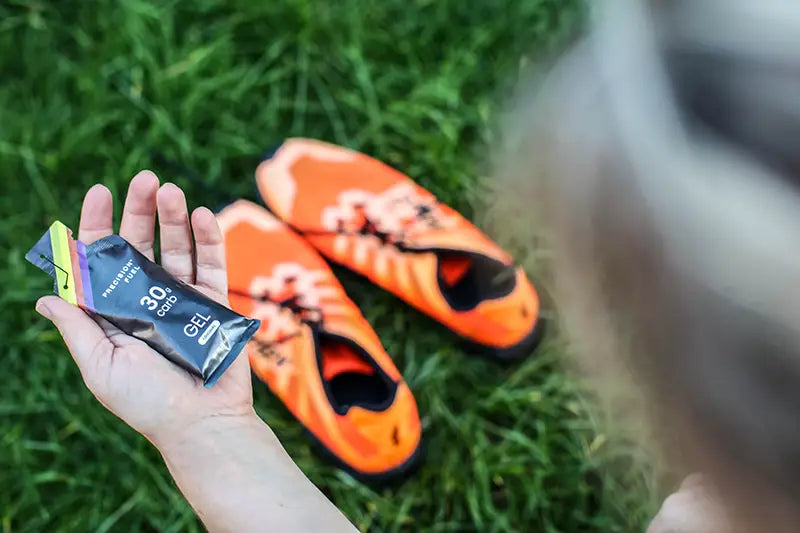
PF30 gel in front of running shoes.

Turn the framework into a starting basket

Give Fuel Finder a session, not just a number

Fuel Finder can turn the event and your preferences into a product-based starting point. Come back to this guide to check the hourly total, carrying, concentration, tolerance and backup before relying on it.

  1. Describe the real session Add duration, intensity, terrain, temperature and access rather than choosing a product first.
  2. Choose what you’ll really use Set fuel-type and caffeine preferences that you can carry, open and tolerate.
  3. Rehearse the result Check current labels, translate products into grams per hour and test the sequence in training.

Choose products after the calculation

Shop for the job, not the headline number

These current collections contained 18 energy gels, 25 energy and hydration drinks and 13 energy bars when rechecked on 26 July 2026. Check each product page for current prices, options and availability.

Energy gels

Compact, labelled carbohydrate portions for periods where chewing or carrying space is limited.

Compare energy gels

Energy and hydration drinks

Compare carbohydrate drink mixes and electrolyte options by the job, concentration and current label.

Compare energy and hydration drinks

Energy bars

Portable solid fuel for steadier periods where chewing and digestion have been tested.

Compare energy bars

Common questions

Endurance fuelling questions, answered plainly

General information for healthy adults. Individual health, medication, diabetes, pregnancy, eating-disorder history and gastrointestinal conditions require qualified personal advice.

How many grams of carbohydrate per hour do I need?

Start with duration and intensity. Established guidance commonly uses 30 to 60 grams per hour for endurance work lasting about one to two and a half hours, with up to 90 grams per hour from mixed carbohydrate sources for longer events. These are broad planning ranges, not automatic minimums. Begin conservatively, then use relevant training to test performance, delivery and tolerance.

Do I need a gel for a one-hour easy session?

Usually not if you start adequately fed and the session is genuinely easy. Ordinary meals and water are often enough. Fuel can still have a clear job for an early fasted start, a second session, a hard hour, heat, a medical need or deliberate event rehearsal.

Should I use drink mix or gels for endurance fuel?

Choose by job. Drink mix can combine carbohydrate and fluid, but you need to measure the concentration. Gels make compact portions easy to count. Chews, bars and familiar food add texture and variety when intensity allows. Many useful plans combine fuel types so the fluid can change without losing the whole carbohydrate plan.

How do I stop gels upsetting my stomach?

Check the current serving, water instructions, total carbohydrate, drink concentration, caffeine, timing and pace. Begin with a lower familiar rate and change one variable at a time in relevant training. Persistent or severe gastrointestinal symptoms, vomiting, blood, fainting or unexplained weight loss need medical or dietetic assessment, not another product experiment.

Should I fuel every training session like race day?

No. Match fuel to the purpose. Easy short sessions can often rely on ordinary meals, while long, hard and event-specific sessions are useful places to rehearse the plan. Avoid accidental chronic under-fuelling, but don’t turn every easy hour into a race simulation or use products without a practical job.

Sources and further reading

Where the ranges come from

These sources combine consensus guidance, systematic reviews, meta-analyses and an IOC health boundary. We’ve translated them into a practical planning framework; the examples aren’t individual prescriptions, and current product labels remain the source for serving information.

  1. Nutrition and athletic performance Academy of Nutrition and Dietetics, Dietitians of Canada and ACSM, 2016

    Joint position paper covering daily, pre-exercise, during-exercise and recovery carbohydrate guidance.

  2. Nutrition for athletics consensus statement World Athletics, 2019

    Evidence-led periodised nutrition across training, competition, health and different endurance demands.

  3. Carbohydrates for training and competition Journal of Sports Sciences, 2011

    Framework for scaling carbohydrate availability and during-exercise intake to the session or event.

  4. Training the gut for athletes Sports Medicine, 2017

    Review of repeated nutrition practice, gastric comfort, absorption and exercise tolerance.

  5. Acute carbohydrate feeding and endurance performance Critical Reviews in Food Science and Nutrition, 2024

    Systematic review, meta-analysis and meta-regression of 136 endurance-exercise studies.

  6. Performance effects of periodised carbohydrate restriction Sports Medicine - Open, 2021

    Systematic review and meta-analysis finding no overall endurance-performance benefit in trained athletes.

  7. IOC consensus statement on Relative Energy Deficiency in Sport British Journal of Sports Medicine, 2023

    Health and performance risks from problematic low energy availability in female and male athletes.

  8. IOC consensus for sport events in the heat British Journal of Sports Medicine, 2023

    Preparation, environmental monitoring, hydration, cooling and event organisation in heat.

  9. Carbohydrate intake in recovery from exercise Current Opinion in Clinical Nutrition and Metabolic Care, 2021

    Rapid glycogen-restoration guidance when another demanding session follows within hours.